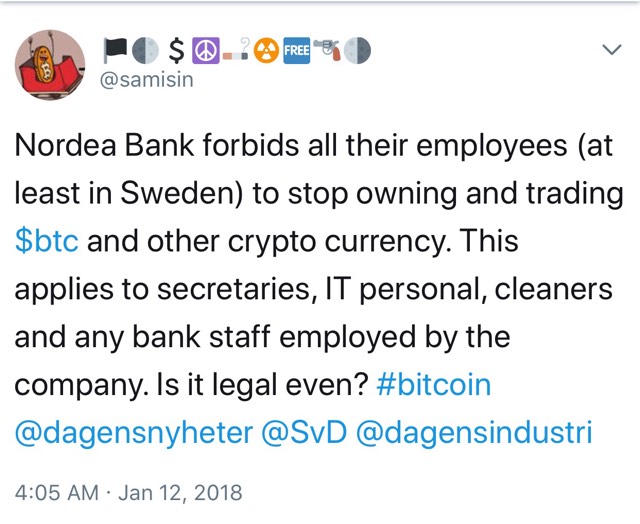
Word spread 12 January 2018 on Twitter Nordea Bank “forbids all their employees (at least in Sweden) to stop owning and trading $btc and other crypto currency. This applies to secretaries, IT personal, cleaners and any bank staff employed by the company. Is it legal even?,” asked Twitter user @samisin.
Nordea Bank AB has more than half a trillion dollars in assets, and is one of the largest banks in Northern Europe. Its alleged move against employees’ cryptocurrencies were not all that surprising when placed in the backdrop of the bank’s executive team’s disparaging public comments. Executives have long worried about cryptocurrency and its lack of regulation, and more recently complained about the fact bitcoin was allowed to exist without jumping through all the hoops of the traditional banking system, referring to the phenomenon as “a joke.”

Bitcoin’s value, however, is exactly that: it could not have existed if brought through the regular cartel channel of state-backed banks such as Nordea. Its precise reason for being is to defy minders and bureaucratic middle persons, landing in the hands of ordinary, uncredentialed and unlicensed peoples.
After News.Bitcoin.com published the story, a whistleblower came forward with documentation on the assurance of anonymity.
According to memorandums obtained by News.Bitcoin.com, a decision by Nordea’s board was made 13 December 2017. The message’s import was to affirm no employees of the bank were allowed to trade bitcoin nor other cryptocurrencies. When queried about what to do with crypto already held by employees, an answer was not immediately forthcoming.
Trade Union Might Take Up Cause
The memos were pulled from Yammer, a social networking site used by some businesses for private communication. Its network is open by invite only.
A second communication from the bank further outlined coming policy: The ban will be effective late February due to “its highly speculative nature, including high investment/volatility risk, and the related tax evasion and money laundering risks,” the source details. New rules also include how unless “otherwise stated, the rules set forth in this section apply to all transactions. Therefore, it is irrelevant whether they are carried out on [a personal] account, on behalf of a Closely Related Person, a customer, the Group, or on behalf of another party within or outside the scope of work,” the memo reads.

Furthermore, “No Employee, Service Provider or Tied Agent at the Group may: Conduct trading in Bitcoins and other Cryptocurrencies.” Exemptions are being provided for if investments “in financial instruments manufactured by Nordea linked to cryptocurrencies. Further, the prohibition does not cover minor investments in cryptocurrency made by employees in product development roles who have a work-related reason to do so, and where the respective Head of the BA/GF has pre-approved the investment following consultation with Group Compliance,” the bank explained. There appears to also be “special circumstances” clause as well.
When the anonymous source was asked about employees’ feelings on the matter, “Regarding the workers, as far as I know many care and think this policy is way to far reaching when it comes to their right to own whatever legal property they wish, and therefore complaints have also been made to the union Finansförbundet,” we were told.
As a result of “complaints by employees,” the 33,000 member trade union Financial Sector Union of Sweden, Finansförbundet, representing bank employees, is reportedly set to discuss a formal response during an internal meeting this Tuesday, 16 January 2018.
Comments
Post a Comment